Nonduality (Advāya)
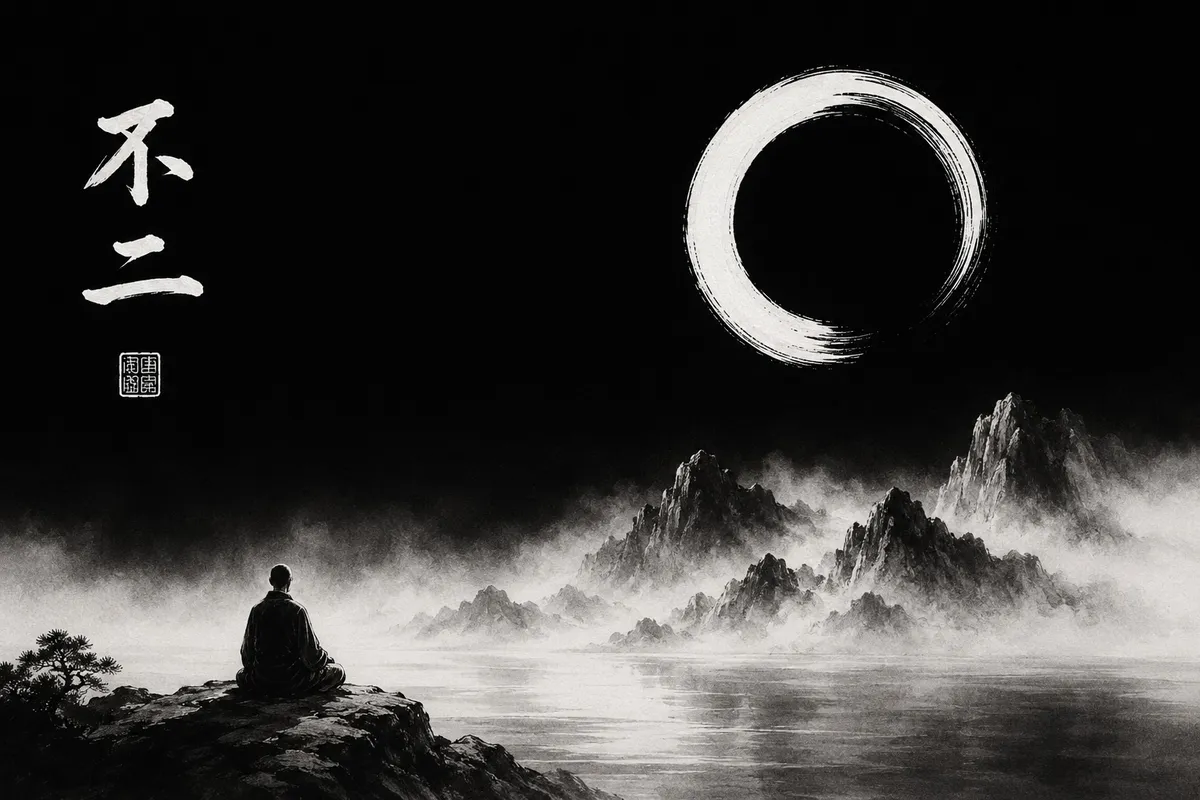
In the previous post we arrived at something that cannot be further refined.
Not Qì; not Shén; not a state; not an experience; not an attainment.
Something that was present before the first exercise, before the first breath, before the first sensation of Qi, and which remained unchanged throughout every stage of practice.
The witness; the knower; that which knows all change without itself changing.
Up to this point I have deliberately avoided comparing this recognition with the teachings of other traditions.
Not because the comparison is unimportant; because it is dangerous. The moment we begin comparing words, we risk mistaking words for what the words point toward.
Yet having arrived here, the question naturally presents itself.
When the Daoists speak of huán xū hé dào (還虛合道): "Returning emptiness to union with the Dao," what are they describing? When the Vedāntins speak of sākṣī, the witness-consciousness, what are they describing? When the Buddha speaks of nibbāna, what is being indicated?
Are these different discoveries? Or different descriptions of one discovery?
I do not know. Neither, I suspect, does anyone else. But the question is worth asking.
The Problem of Names
Imagine three people standing on different sides of a mountain.
One describes forests. Another describes cliffs. A third describes rivers.
Their descriptions differ because their perspectives differ; yet all three may be looking at the same mountain.
Spiritual traditions face a similar problem: a Daoist practitioner begins with Qì; a Vedāntin begins with inquiry; a Buddhist begins with direct observation of experience.
The methods differ; the language differs; the metaphysics differ.
Yet when the descriptions reach their highest point, certain similarities begin to appear: something unborn; something unconditioned; something beyond thought; something that cannot be possessed; something present before the appearance of the individual self.
These similarities do not prove identity; but they are difficult to ignore.
Not One, Not Two
The Sanskrit term most relevant here is advāya. It is often translated as “nondual.” Literally it means “not two.”
But notice that it does not say “one.”
This distinction matters. If I say there is only one thing, I have already created a concept. I have turned reality into an object that can be counted.
The sages are pointing to something subtler. Before the mind divides experience into subject and object, self and world, observer and observed, there is simply what is.
The division comes later. The division is useful. The division is necessary for ordinary life. But the division is not fundamental.
The wave appears separate from the ocean; but the wave is never actually separate from the ocean.
Likewise, the individual appears separate from reality.
The appearance may be convincing; but the separation is never complete.
This is why many traditions prefer the language of “not-two” rather than “one.” The first removes a mistake; the second creates a theory.
Brahman Is Not Brahmā
At this point a clarification is necessary. Many readers encounter the word Brahman and assume it refers to Brahmā, the creator deity of Hindu mythology.
They are not the same thing. Brahmā is a deity; Brahman is the unconditioned absolute.
One belongs to the realm of names and forms; the other is that within which names and forms arise.
The Upaniṣads describe Brahman as infinite, unborn, deathless, and beyond all predicates.
Not because it is mysterious; because every description limits what is described.
The finger cannot contain the moon; words cannot contain the absolute—they can only point.
Does Recognition Require Belief?
No. This is perhaps the most important point. Recognition does not depend upon philosophy. The witness was present before you learned the word “witness.” The Dao was present before you learned the word “Dao.”
Reality does not require your agreement. A child has no metaphysical vocabulary; yet awareness is present. A dog has no doctrine; yet awareness is present. A realized sage may speak ten languages or none; awareness remains present.
Words are maps; recognition is territory. The map may help; but the map is never the place itself.
Different Peaks, Different Paths
At this point some readers conclude that all spiritual traditions are therefore identical. That conclusion does not follow. Even if different traditions are pointing toward the same recognition, the paths remain different.
A mountain may have many trails. Some are steep; some are gradual; some are dangerous; some are beautiful.
The fact that several trails lead toward the summit does not make the trails identical.
Daoist internal alchemy remains Daoist internal alchemy; Vedānta remains Vedānta; Buddhism remains Buddhism.
Each possesses its own methods, assumptions, disciplines, and strengths.
Respecting the common recognition does not require erasing the differences. In fact, genuine respect requires acknowledging them.
One Recognition, Many Names
Perhaps the wisest position is neither certainty nor denial. Perhaps it is simple openness.
The Daoists discovered something. The sages of the Upaniṣads discovered something. The Buddha discovered something.
Whether these discoveries are ultimately identical is less important than many people suppose.
What matters is that each points beyond concepts toward direct recognition.
Toward that which cannot be refined; toward that which cannot be attained because it was never absent; toward that which remains when every description has fallen silent.
The names differ. The recognition may not.
And if that is true, then the recognition existed long before any of the names.
→ Next post in the Series ← Back to The Missing Step Series