The Collapse of Identity
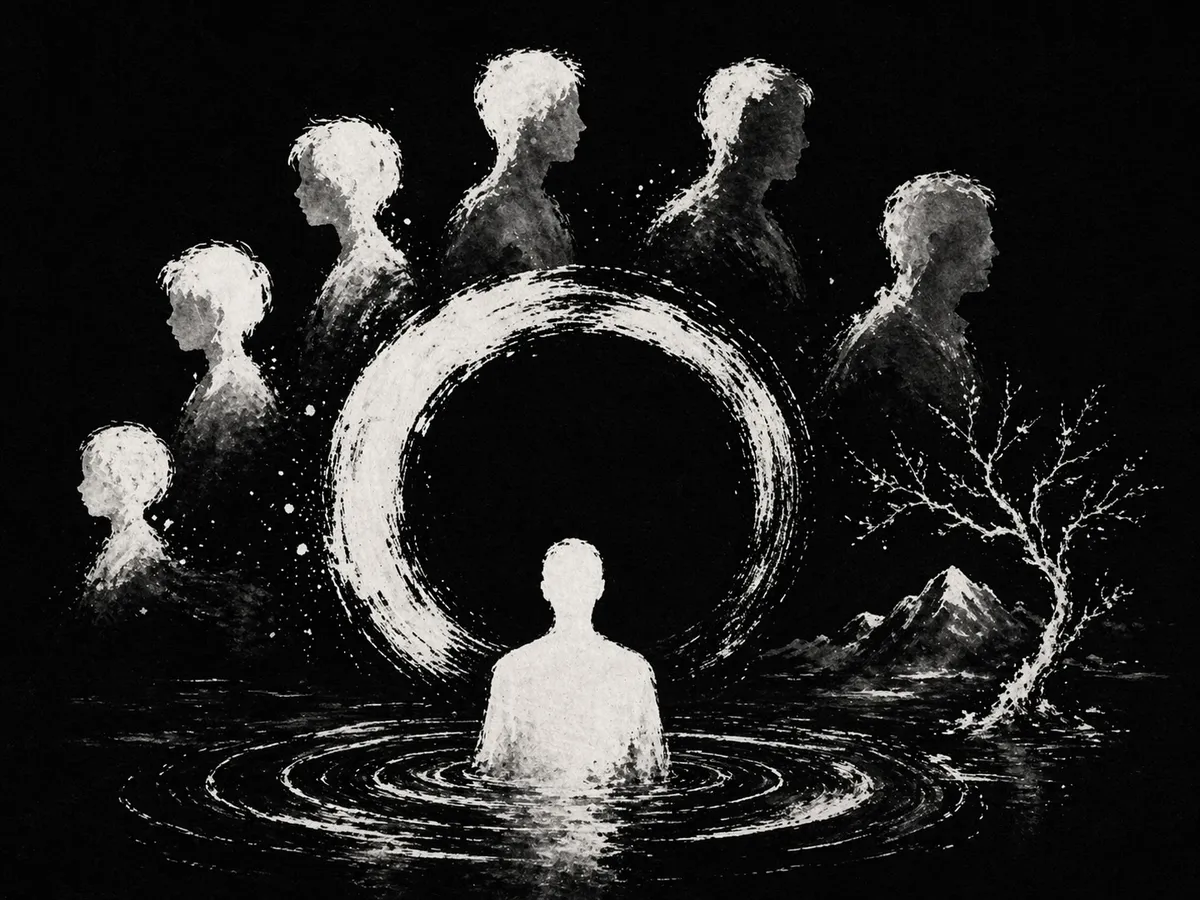
It often feels obvious: “I know who I am.”
There doesn’t seem to be much doubt about it.
You have a name. A history. A set of preferences and tendencies.
All of it appears to form something consistent.
Something you can point to and say: "This is me."
⸻
But if you look closely, it doesn’t hold in quite the same way.
You move through different situations.
And something shifts.
The way you speak. The way you think. The way you respond.
At work, you are one thing. With friends, another. Alone, something else again.
These shifts are subtle, but they are there.
It is often explained as “playing roles.”
But if they are roles, which one is the real one?
⸻
You can go further.
Think back to how you saw yourself years ago.
Childhood.
Adolescence.
Even a few years back.
The sense of “I” was there.
But what it referred to has changed.
Almost completely.
⸻
The person you believed yourself to be then is not the same as the one you believe yourself to be now.
And yet, in both cases, it felt certain.
So what exactly was that certainty about?
⸻
If you look at what you call identity, it seems to be made of a few things:
Memory. Images. Ideas about yourself.
A kind of ongoing story.
You remember certain events.
You interpret them in a particular way.
You connect them into a narrative.
And from that, a sense of self is formed.
⸻
But memory is not fixed.
It shifts.
Details are added. Removed. Reinterpreted.
Even the emotional tone of a memory can change over time.
⸻
Imagination plays a role as well.
You picture who you are.
Who you have been.
Who you might become.
These images influence how you see yourself now.
And projection.
You anticipate how others see you.
You adjust accordingly.
That becomes part of the identity too.
⸻
So the “self” is not a single, stable thing.
It is assembled.
Continuously.
And the assembly never quite stops.
Even the sense of “I” itself is not as fixed as it appears.
It feels constant.
But what it attaches to is always shifting.
⸻
“I” as a child. “I” as an adult.
Same word.
Different content.
The continuity is assumed—not verified.
⸻
If you look directly, without relying on the story, something becomes less clear.
There is no single, unchanging identity that can be found.
Only changing thoughts. Changing roles. Changing interpretations.
And this can feel unsettling.
Because if the identity is not stable, what exactly are you?
⸻
That question does not have an immediate answer.
And in that absence, something appears.
A kind of groundlessness.
Not as a concept.
But as a direct sense that nothing you can point to fully defines you.
The usual reference points don’t hold in the same way.
The narrative weakens.
The certainty fades.
⸻
And yet, all of this is being noticed.
The shifting roles. The changing story. The uncertainty itself.
⸻
If what you are keeps changing…
what is it that notices the change?
→ Next post in the Series
← Back to The Missing Step Series