The Wordless Transmission
There is a moment, if one stays with practice long enough, when something unsettling becomes obvious:
What is being learned is not coming through the words.
The posture may be described. The breathing can be outlined. Even the sequence can be memorized.
But the thing itself—what animates the practice, what makes it alive—arrives by another channel entirely.
The Chinese tradition has always known this, though it rarely states it directly.
⸻
Dá Mó and the Beginning of Silence
The story begins, as these things often do, with Dá Mó (達摩, Bodhidharma).
When he is said to have brought the marrow of practice to Shàolín, the emphasis was not on instruction but on direct seeing. The later phrase in Zen—jiào wài bié chuán (教外別傳): “a transmission outside the teachings”—is not a poetic flourish. It is a technical statement.
What is transmitted is not doctrine.
It is a condition.
If we translate this into Vedāntic language, we would say: it is not śabda (verbal teaching) that liberates, but aparokṣa-anubhava (direct, immediate knowing). The words prepare; they do not deliver.
⸻
From Form to Intention: Wáng Xiāng-Zhāi
This thread becomes explicit much later in the work of Wáng Xiāng-Zhāi (王薌齋).
Wáng dismantled the elaborate forms of Xíng-yì and pointed toward something more primary: yì (意), intention itself.
His insight was surgical:
If the form is correct but the yì is absent, nothing happens. If the yì is correct, the form becomes secondary.
This is already a movement away from the visible toward the invisible—from what can be shown to what must be caught.
And this “catching” cannot be done through explanation.
⸻
Professor Yú Péng-Sī: Opening the Channels
With Professor Yú Péng-Sī (余彭司), the matter becomes physiological.
The material in Xīn-yì: Combat Without Contact describes a crucial turning point in his life: under the guidance of his Buddhist master, his Qì channels were opened—not gradually through technique alone, but through direct intervention.
From that point forward, his understanding of martial and meditative practice fused.
The text makes a striking claim:
- When the channels are fully opened, the body can deliver vastly increased oxygen and energy to each cell
- Aging slows
- Strength and mental clarity increase dramatically
But more interesting than the claims is the method:
The opening did not occur through verbal instruction.
It occurred through contact—not necessarily physical contact, but energetic alignment.
This is the first clear indication of what we are calling here "the wordless transmission."
⸻
Madam Ōu-Yáng Mǐn: The Living Example
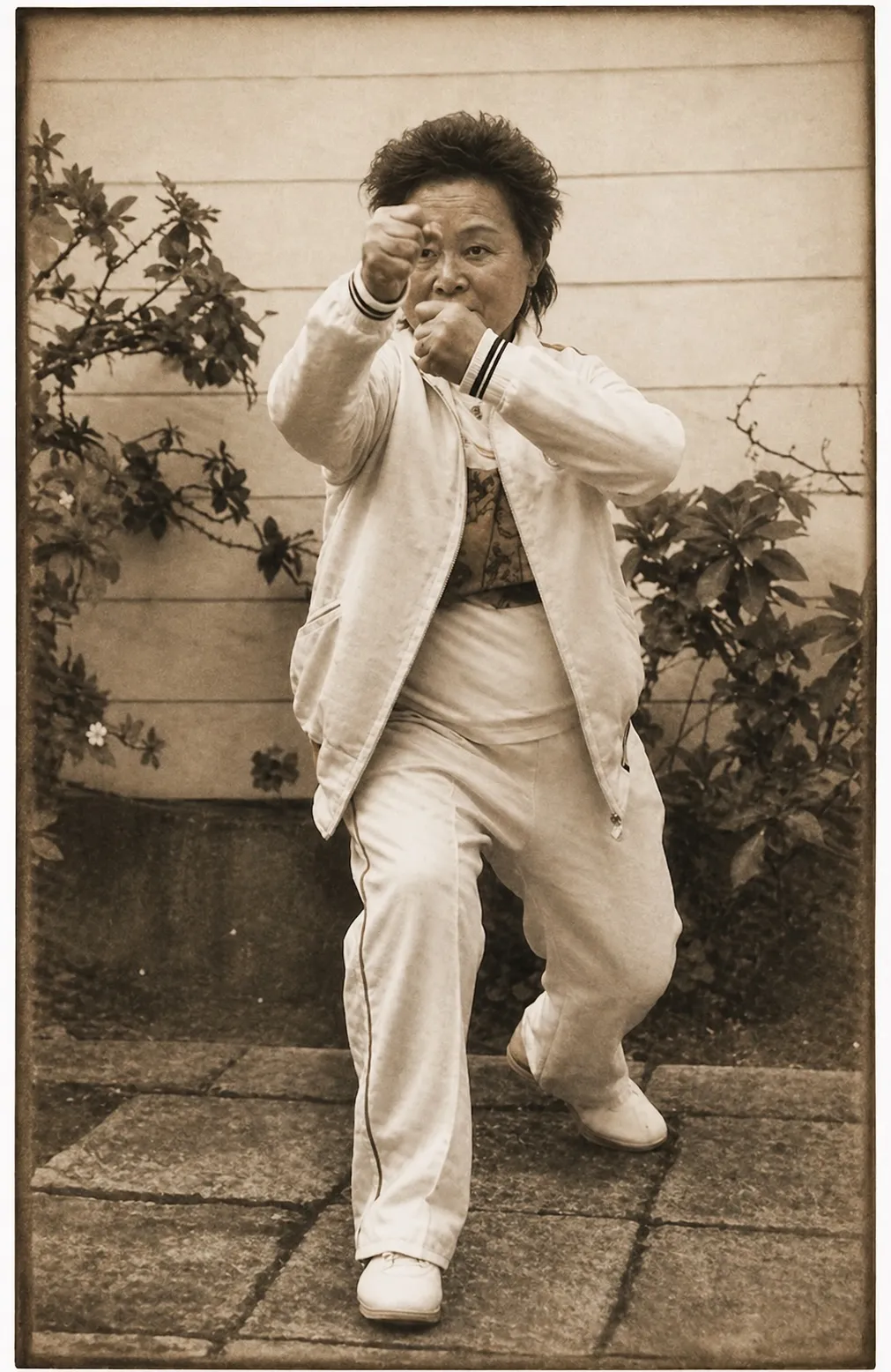
This reaches its most concrete expression in Madam Ōu-Yáng Mǐn (歐陽敏).
By the time she was teaching in San Francisco—well into her 80s—students reported phenomena that sound, at first glance, like exaggeration:
- Being moved or thrown without physical contact
- Experiencing force at a distance
- Feeling internal changes simply by standing near her
The article describes “empty force” (kōng jìng) not as mysticism, but as a natural extension of highly developed internal practice.
Now, one can debate the interpretation of such accounts. That is not our concern here.
What matters is this:
Her students did not primarily learn by being told what to do; they learned by being in her field.
⸻
What Is Actually Transmitted?
Let us be precise.
It is tempting to say that “energy” is transmitted. This is close, but not exact.
What is transmitted is a state of organization in the subtle system.
In Sanskrit terms, we might say:
- A certain alignment of prāṇa
- A certain steadiness of citta
- A certain clarity of buddhi
When one stands in proximity to such a system, one’s own system begins—very subtly—to entrain to it.
This is not mystical in the sense of being arbitrary. It is lawful, though not yet fully modeled.
In modern language, we might call it resonance.
In Daoist language, it is simply natural.
⸻
Why Words Fail Here
Now we can see the limitation of verbal teaching.
Words operate at the level of concept (vikalpa). But the transmission operates at the level of structure.
You can describe relaxation endlessly. But until the nervous system recognizes it, nothing changes.
You can define Qì. But until it is felt, the definition is hollow.
This is why the series began with the inversion:
The video is the practice. The writing is only words for what you saw.
The classics say:
得意忘言 dé yì wàng yán — grasp the meaning, forget the words.
But even this is slightly misleading.
It is not that the words are later forgotten.
It is that the words were never the carrier.
⸻
The Second Seed: Words Are Not the Substance
Here, quietly, the second seed is planted.
If real teaching can pass without words, then:
Words are not the substance of what is being taught.
This has consequences that extend far beyond Qìgōng.
It means:
- Doctrine is secondary
- Systems are provisional
- Explanation is scaffolding, not structure
And more subtly:
What you are actually seeking cannot be delivered as content.
⸻
A Vedāntic Reflection
In the Upaniṣadic tradition, this insight appears in a different language:
yato vāco nivartante aprāpya manasā saha — “From which words return, along with the mind, not having reached it.”
And again:
nāyam ātmā pravacanena labhyaḥ — “This Self is not attained by discourse.”
The resonance is exact.
The Chinese master does not say this in Sanskrit.
The ṛṣi does not speak of Qì.
But both point to the same structural limitation:
That which matters most cannot be transmitted as information.
⸻
Practical Implication for the Reader
So what does this mean, concretely, for someone encountering this series?
Very simply:
Do not try to understand the practice through the writing.
Let the writing orient you. Let the video show you. But allow the body to do the actual learning.
Stand.
Breathe.
Wait.
If something begins to organize itself without your effort—a subtle settling, a quiet coherence—that is the beginning of transmission.
⸻
Toward the Next Step
We are now in a position to see something that was invisible at the start:
There is a gap between doing the practice and understanding the practice.
Most systems try to fill that gap with more explanation.
This tradition does something else.
It leaves the gap open— and allows transmission to cross it.
In the next post, we will begin to name the forces involved:
Not as abstractions, but as things that can be felt.
→ Next post in the series
← Back to Three Treasures Qigong