What Is Being Practiced?
Part I — Approach
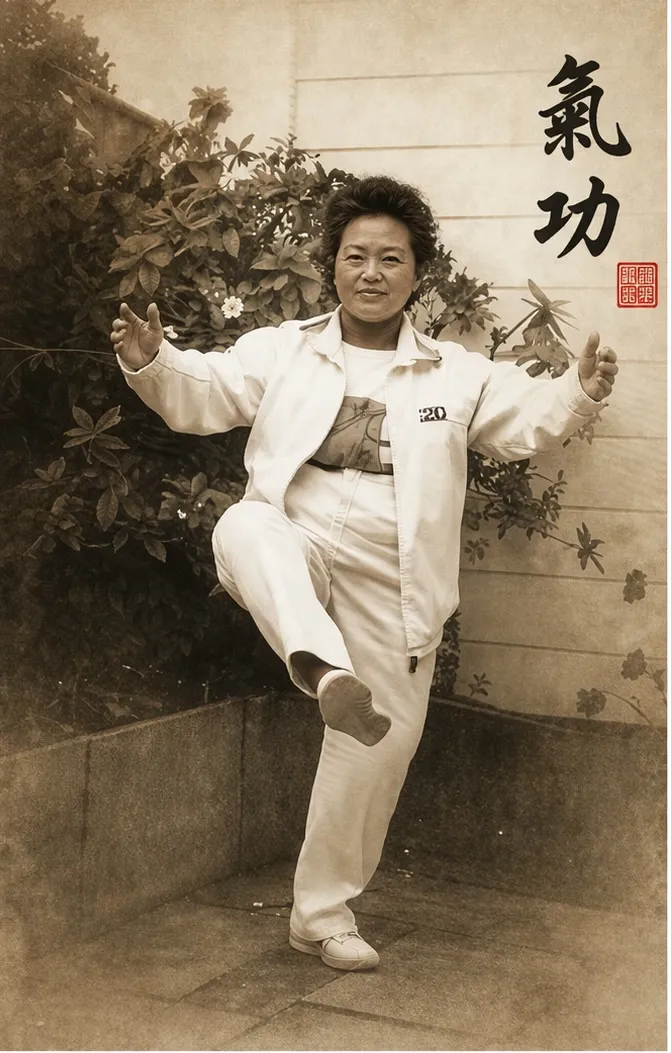
1. What Is Being Practiced?
Maybe you've just watched the video. Or maybe you arrived some other way — a friend forwarded it, an algorithm served it up at the right hour, a thread you'd been following for a while finally landed somewhere. Either way, you arrived with a question that probably isn't yet a question. It's more like a residue. Something was being pointed at, something with weight to it, and the words used to point — qì, qìgōng — didn't immediately resolve into anything you could hold.
Good. Stay there for a moment. That unresolved feeling is the right place to start.
The question your body has been quietly asking
What's the question, exactly? It's the one your body keeps asking when you finally sit still — when you notice that you have a sense of yourself that isn't your thoughts, isn't even your sensations exactly, but is something more like a current running underneath both. When you feel tired in a way that food doesn't fix and sleep only partly does. When you walk into a room and notice it has a quality. When the person standing beside you has a quality. When a tree on the path home seems to push back against you slightly as you brush past it.
None of these are concepts. They are simply there, lived, before any vocabulary arrives to name them.
Qì (氣) is the word the Chinese tradition gives to what your body has been noticing all along. It is not first a doctrine; it is first a response to a question that wasn't fully formed. The older form of the character is suggestive — vapor or steam rising, something seen but not solid, present but not graspable. That's already most of what you need. Qì is what's there when you stop reaching for what's there.
The tradition broadens the term as needed. Heaven has its qì — what we would call weather, climate, the felt state of the sky. Earth has its qì — terrain, magnetism, the heat under the soil, the quality of a place. Every living thing has its own qì. The word also stretches to describe the condition of energy: a person can have righteous qì, or low qì, or vital qì, or even — when life departs — dead qì. So even before we begin practicing anything, we already have a richer vocabulary for the felt world than English easily provides.
For our purposes — meaning, anyone reading this who is not a meteorologist or a geomancer — qì refers specifically to human qì. And within that, there are layers. There is the original qì you are born with, closer to what we might call constitution or inheritance. There is the qì derived from breath. The qì derived from food. The qì influenced by environment, exercise, mood, and the company you keep. The original qì is more or less fixed. Everything else can rise, fall, balance, or fall out of balance.
Most of why you would practice qìgōng is to do something useful about that.
Gōng — work, not technique
Now the second word, and a frequent point of confusion. Gōng (功) is often misread as a kind of exercise — as if "qìgōng" meant something like "the qì routine." That is roughly as accurate as calling a violin sonata "the bowing technique."
Gōng means work — but not work in the sense of a chore. It means the kind of work that requires strength, skill, talent, persistence, and time. It is the same gōng that appears in gōngfū (功夫), which almost every English speaker has heard, and almost none realize simply means long-time skilled work. Gōngfū can apply to calligraphy, to cooking, to medicine, to carpentry — to anything where mastery is not a weekend's affair.
So qìgōng is not a technique. It is not a routine. It is the long, patient, skilled cultivation of one's relationship with qì. The exercises are the alphabet, not the literature. You can learn the alphabet in an afternoon. You will spend the rest of your life — if you choose to — learning to write.
This distinction matters because it sets expectations correctly from the start. Qìgōng rewards practice the way gardening rewards practice. You do not acquire qì the way you acquire a skill in a video game. You become someone whose qì is more available, more balanced, more responsive to intention — gradually, through return after return to the same simple work.
Why "energy" is a bad translation, and the best one we have
When English speakers translate qì, they almost always reach for "energy." This is unsatisfying, for several reasons.
"Energy" in English is a physics term first — the capacity to do work, measurable in joules, transferable between heat and motion and electromagnetism. Qì is not less than that, but it is much more than that. It is also relational, qualitative, and animate in a way the physics term does not quite reach. A room has qì. A handshake has qì. A meal has qì. A piece of music has qì. None of these are joules.
The word is also unsatisfying because, in contemporary English, it has been worn smooth by overuse. Energy drinks. Motivational energy. "Good energy," "bad energy," vibes, frequencies. The word now points to almost nothing — which is a strange fate for a word that, in Chinese, points to almost everything.
And yet. Energy is still the best single-word translation we have. Every other candidate fails worse. Spirit drags in religious freight qì does not carry. Force sounds mechanical, like a Star Wars prop. Vitality is too narrow — qì is not just liveliness. Life-force is closer but starts to sound mystical in a way that may put off the very reader most likely to benefit. So we use energy, knowing it underdescribes, and we let practice fill in what the word can't carry. The understanding has to come from the body, not the dictionary.
This is worth keeping in mind every time the word appears here. Translate "energy" back into your own felt sense of qì as you read. The English word is a placeholder; you are doing the actual work.
The cross-cultural question
A reasonable question, raised early by anyone with a comparative bent: is qì the same thing other traditions have been pointing at?
The Indian yogic tradition speaks of prāṇa — the breath, and also the living force the breath carries. The Hebrew scriptures speak of rūaḥ — wind, breath, spirit. The Greek New Testament speaks of pneuma — also wind, also breath, also spirit. Polynesian traditions speak of mana. The Sufis speak of baraka. The list extends as far as one cares to follow it, and the cross-cultural pattern is striking: nearly every tradition that thinks carefully about the living body arrives at something like a wind, a breath, a current, a charge — with both physical and more-than-physical aspects.
Are these the same thing under different names?
It would be tidy to assert so. But that would be moving faster than the evidence allows, and possibly papering over real differences in how each tradition understands and works with what it is pointing at. Prāṇa lives within a yogic framework of kośas (sheaths of the embodied self) and nāḍīs (channels) that does not map perfectly onto the Chinese system of meridians and dāntián. The Mediterranean terms — rūaḥ, pneuma — point more toward divine inspiration than toward something cultivable through self-directed practice.
So it is better to pose the equivalence as a question and leave it open: these traditions appear to be looking at something similar, perhaps even the same, and they have arrived at strikingly compatible vocabularies for it. Whether the underlying reality is one or many is a question that practice — not argument — slowly answers.
For now, hold the resemblance lightly. Notice it. Use it where it helps. Do not force the systems to merge before you have felt your way around any one of them.
That is what is being practiced. Not a technique. Not a fitness routine. Not a translation problem. A patient cultivation of a relationship with something your body has always known and your culture has rarely given you words for.
What to actually do with that — that comes next, once this much has settled in.
→ Next post in the series
← Back to Three Treasures Qigong