The Language of Qì
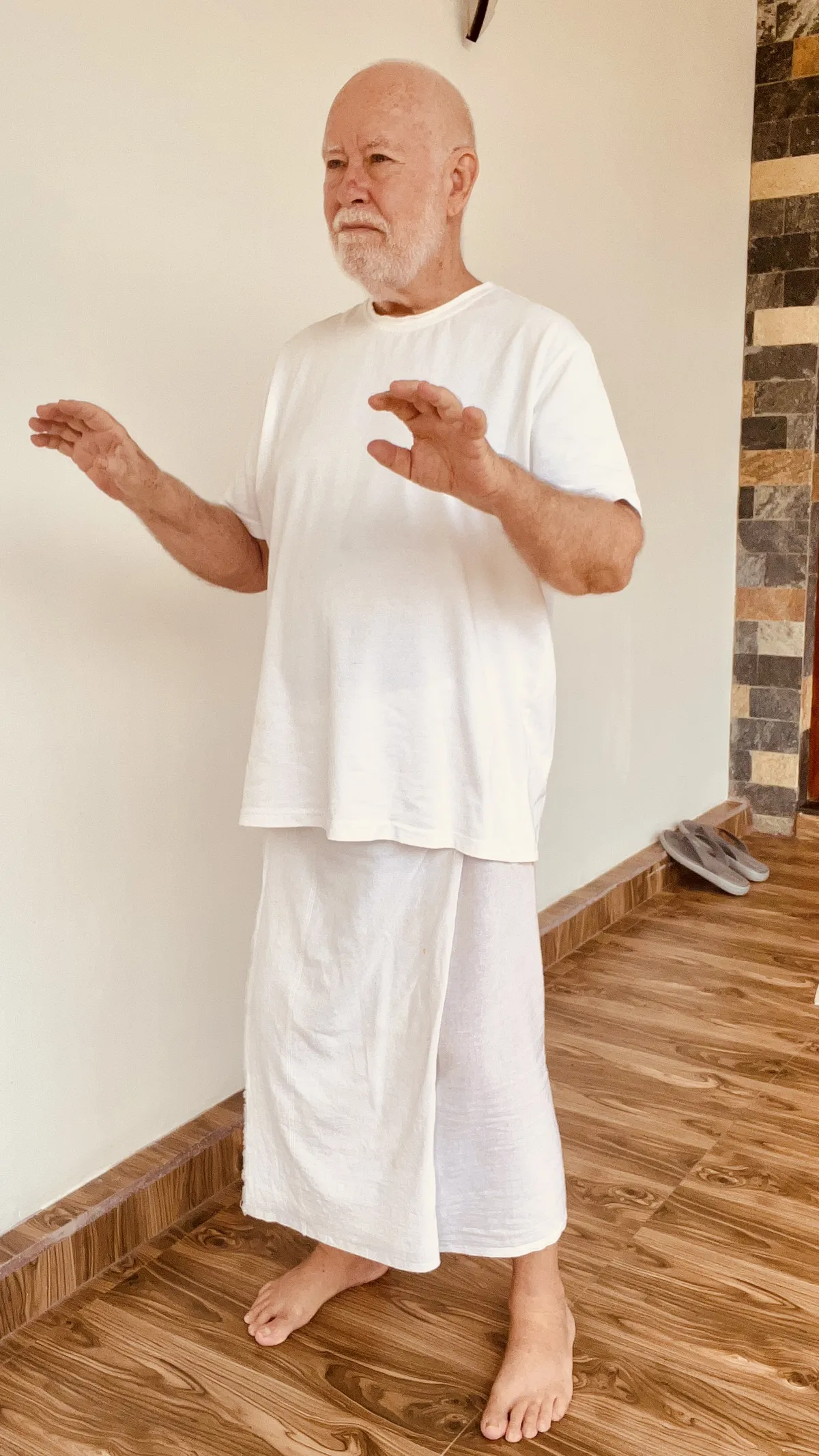
You have watched the video, perhaps a few times. You have stood. Maybe only for two or three minutes the first day, a little longer the next, and on some morning in the second week you noticed your shoulders had dropped without your asking them to. You may not have thought it amounted to much. But something has now landed in your body that was not there before — a small, particular knowing about what it feels like to stand and let energy do its work.
Now the language is useful. Not before. Before, the words would have been just words — bundles of unfamiliar syllables to be filed away. Now they have something to point at, in your own experience.
This is the principle behind the order of these posts. The video came first. The standing came first. The vocabulary, deliberately late.
Three meanings of Qì
We have already met Qì (氣) as energy. That is its broadest meaning. But Chinese usage carries the word further, and the further reaches matter for practice.
A second meaning is qualitative. Qì can describe not just the substance of energy but its flavor in a particular being or place. People say “He has a lot of yáng Qì” — meaning vigorous, outgoing, warm, expansive. Or “Her Qì is yīn today” — quieter, contained, cooler. A morning has Qì. A meal has Qì. An argument has Qì. The word lets us describe the felt quality of the energy in any situation, in any body, without straining the language.
A third meaning is state-related. Qì describes the condition or status of energy at a given moment: rising, falling, stuck, flowing, gathered, scattered. This is the meaning most useful in self-observation. How is the Qì in my chest right now? That question has a felt answer, and the language lets you record it: agitated, settled, heavy, light, dense, thin. You begin to notice that Qì has weather.
So Qì does three jobs at once: It names the substance, the flavor, and the state. None of these meanings exclude the others; they layer. When you read or hear the word Qì, let context tell you which sense is being used. Often it is more than one at the same time.
Yì — intention, and the central principle
A second character has to enter the vocabulary now, because without it the rest of practice cannot be discussed. That character is Yì (意).
Yì is usually translated as intention, sometimes as wisdom mind. It is the directing, willing, purposeful part of mind — distinguished, in the tradition, from xīn (心), the emotional or reactive mind. Yì is the calm director. Xīn is the boy in the back of the classroom. Both are part of you; they are not doing the same job. Most of what you take for granted as "what I'm thinking" is actually xīn — reactions, preferences, moods, narratives. Yì is quieter and steadier, and it has to be developed before it can do much.
The central operating principle of Qìgōng is this: Qì follows Yì. Yǐ Yì yǐn Qì (以意引氣): use Yì to lead Qì. The Chinese verb for "lead" matters. Qì cannot be pushed. It is, in this respect, like water: you cannot make it go somewhere by forcing it. But you can lead it. Place your attention somewhere — softly, with interest, without strain — and the Qì comes. Try to drive it, and it scatters or stalls.
This is something you can verify in your own practice. Hold your hands a few inches apart. Do not move them. Just place attention in the space between them and wait. After a while, something starts to feel — warm, charged, slightly resistant, the air between your palms thickened. That sensation is your Yì leading your Qì. It is not imagination. It works because the body is wired this way, not because you believe it works.
For readers coming from the Indian tradition, Yì is recognizable as something like the vijñānamaya-kośa, the intelligence-sheath in the Vedāntic anatomy of the inner person. The mapping is rough but useful; we will sharpen it later.
Yīn, Yáng, and the language of change
Once we have the third meaning of Qì — Qì as state — a whole grammar opens up. We need a way to talk about energy states, and Chinese gives us one: yīn (陰) and yáng (陽), and the shifts between them.
Yīn and yáng are not values. They are not good and bad. They are not, in any tidy sense, feminine and masculine. They are polarities — pairs of qualities that arise together and define each other: receptive and active; cool and warm; stillness and motion; inward and outward; hidden and revealed. Wherever one of these qualities appears, its counterpart is implied somewhere in the same field. The Chinese tradition treats this pairing as the basic grammar of how anything changes, in the body or out of it.
Every organ, every situation in life, every moment of practice has a yīn-yáng character — and that character can shift. The Qì in your liver might be yáng today and more yīn tomorrow. An evening sitting or standing meditation might begin yáng (a little restless, the day's residue still active) and resolve toward yīn over forty minutes. Knowing this gives you a way to notice and name what is happening without judging it.
This way of describing the world found its most concentrated expression in the Yì Jīng (易經), the Book of Changes — one of the oldest works in the Chinese canon. The book diagrams every possible configuration of yīn and yáng across six lines, generating 64 hexagrams that correspond to the 64 basic patterns of change. “All changes move in six stages, and the seventh brings return.” Most people encounter it as a system of divination. More interestingly, it is a language — a way of describing the state of energy in any situation, with enough resolution to be useful.
You do not need to study the Yì Jīng to practice Qìgōng. But it sits behind the practice as grammar sits behind a sentence: you do not have to name it to use it, but knowing it is there is helpful.
The cakra system as a complementary anatomy
The Indian tradition gives us a different — and complementary — way of mapping the subtle body. Where the Chinese map uses meridians and three dāntián (丹田, fields of elixir) at the lower abdomen, the middle chest, and the head, the Indian map uses seven cakras arranged along the vertical axis from perineum to crown.
These two anatomies are not the same. The cakra system has more named centers. The meridian system has a denser network of channels. They were developed in different cultures with different practical concerns, and they do not translate into each other line-by-line. But for a practitioner, they describe the same body. The energy you cultivate at the lower dāntián sits very close to where the second and third cakras are described in the yogic system. The radiance that develops at the upper dāntián sits near where ājñā- and sahasrāra-cakras are described. The maps cover similar terrain in different vocabularies.
I introduce the cakra language here because many readers will already know some of it from yoga, and because it gives English-speakers a parallel set of handles to use. The seven centers, beginning at the base:
- mūlādhāra (root)
- svādhiṣṭhāna (sacral)
- maṇipūra (solar plexus)
- anāhata (heart)
- viśuddha (throat)
- ājñā (brow)
- sahasrāra (crown)
The lower three are especially relevant to Qìgōng — they are where Qì is generated, stored, and circulated before it rises to the upper centers. Beginning at the bottom and building upward is the right order. The upper centers cannot be developed if the lower ones are starved.
A note on transcendental nomenclature
You have now noticed that this post has used vocabulary from at least two traditions in close proximity. And you may have noticed, while reading, that the systems seem to be circling something common — that Yì, Qì, prāṇa, the kośas, the meridians, the cakras, all seem to be tracking one thing, told in different ways.
Are they?
That question deserves much more space than this post can give it, for it is one of the more interesting questions in this series. The traditions converge in some places and diverge in others. The convergences may be real, or they may be artifacts of translation, or — the most interesting possibility — they may be real because every tradition that looked carefully at the embodied human eventually saw the same territory, and had to coin words for what it found.
We feel that this question is best left open for now, and best approached through practice rather than argument. Words can mislead; practice does not. We will come back to the question of nomenclature directly much later in the series, when there is enough shared experience to discuss it without confusion.
For now, hold the parallels lightly. Notice them where they help. Let your body be the place where the languages meet.
Three weeks ago you might have looked at this post and seen a wall of unfamiliar terms. Now, perhaps, after some Qìgōng practice, some of them have something to land on: Qì in three meanings; Yì leading Qì; Yīn and yáng and their interplay. Two anatomies of the subtle body, neither final, pointing at what cannot be seen but can be felt.
Enough vocabulary for a while. The next post returns to the body.
→ Next post in the series
← Back to Three Treasures Qigong